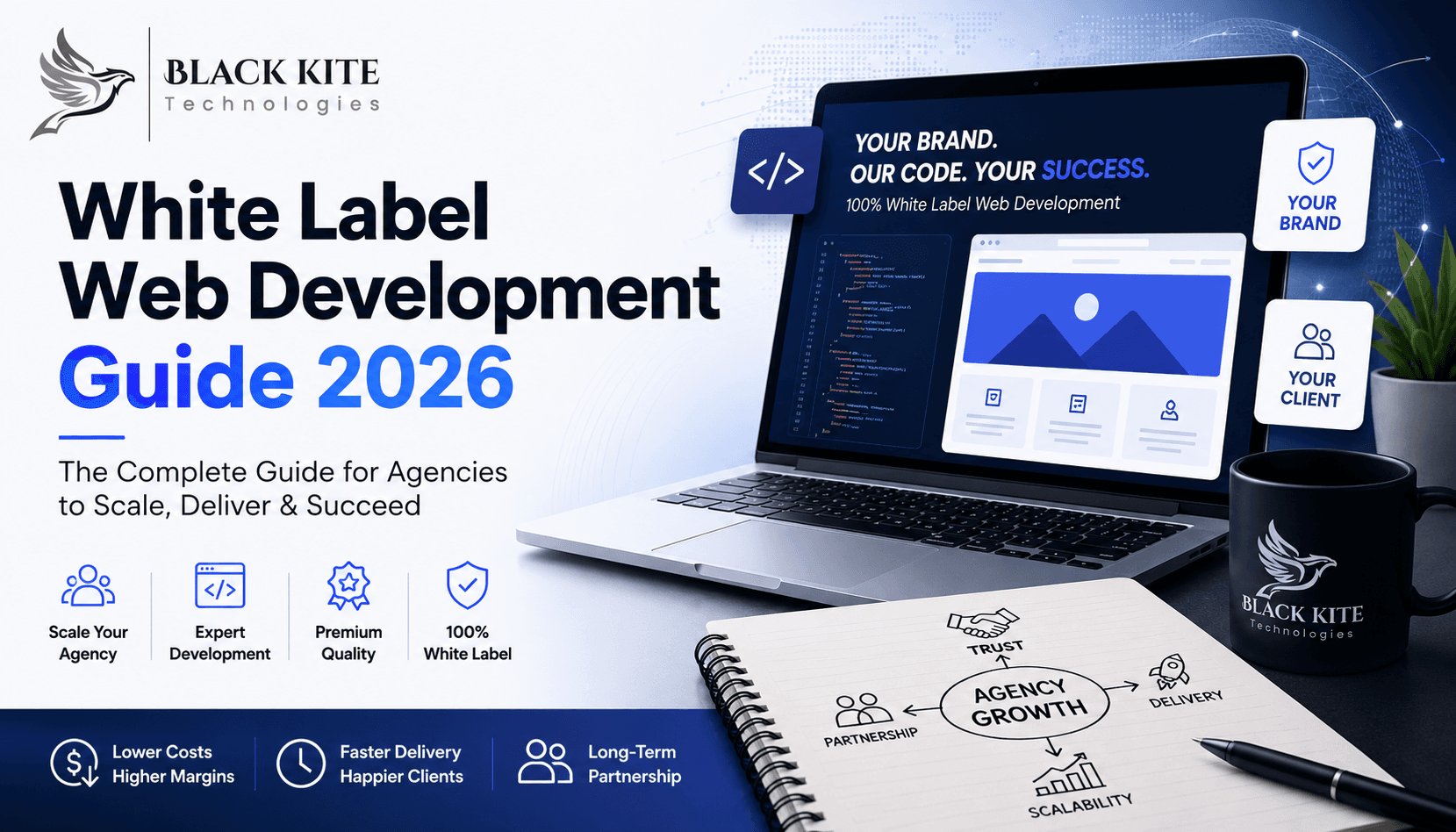
If you run a digital agency, you’ve likely faced this challenge: a client needs a website or custom software development, but your development team is already at capacity, and hiring full-time developers for a single project isn’t practical. That’s where White label web development becomes a game-changing solution. By partnering with a trusted white label web development agency, you can deliver high-quality websites and web applications under your own brand, scale your services without increasing overhead, and take on more client projects with confidence.
According to industry reports, the global web development market continues to expand significantly as organizations priorities digital experiences, automation, and AI-powered solutions. For digital agencies, this creates enormous opportunities but also introduces new challenges.
Many agencies struggle with:
- Finding experienced developers
- Managing increasing client demands
- Hiring expensive in-house teams
- Meeting tight project deadlines
- Scaling operations without increasing overhead
So you do one of three things: turn the project down and hand revenue to a competitor, scramble to find a freelancer who may or may not deliver, or stretch your existing team until someone burns out.
White label web development solves all three of those problems and your client never needs to know a third party was involved.
According to Grand View Research, the global IT services outsourcing market is expected to reach USD 807.9 billion in 2025 and grow to more than USD 1.2 trillion by 2030, reflecting a strong 8.6% compound annual growth rate (CAGR). The white label services market is on track to hit $99.19 billion by end of year. Agencies that learn to say yes to more projects reliably and profitably are the ones growing fastest.
This guide covers everything: what white label web development actually is, how the delivery model works in practice, what it costs, how to structure pricing for healthy margins, the legal protections you need, and how to find a partner you can genuinely trust.
What Is White Label Web Development?
White label web development is a business arrangement where a third-party development company builds websites, web applications, or digital products on your behalf and you present that work to your clients entirely under your own brand.
The development partner operates in the background. No mention in meetings. No branding in the codebase. No footprint in the deliverables. From your client’s point of view, the work came from your agency.
Think of it like private-label products. A supermarket doesn’t manufacture the cereal on its shelves; a specialist does, but the store’s own label goes on the box. The same logic applies to web development:
- Your agency owns the client relationship, sets the price, and receives the credit
- Your white label development partner handles technical execution silently
This model has existed in manufacturing and product businesses for decades. What’s changed is how seamlessly it now works for software and web services, thanks to mature remote collaboration tools, standardized development workflows, and offshore teams in countries like India that produce genuinely agency-grade output at a fraction of US and UK hiring costs.
How Does White Label Web Development Work?
Understanding the actual process removes the anxiety most agency owners feel the first time they consider white labelling development.
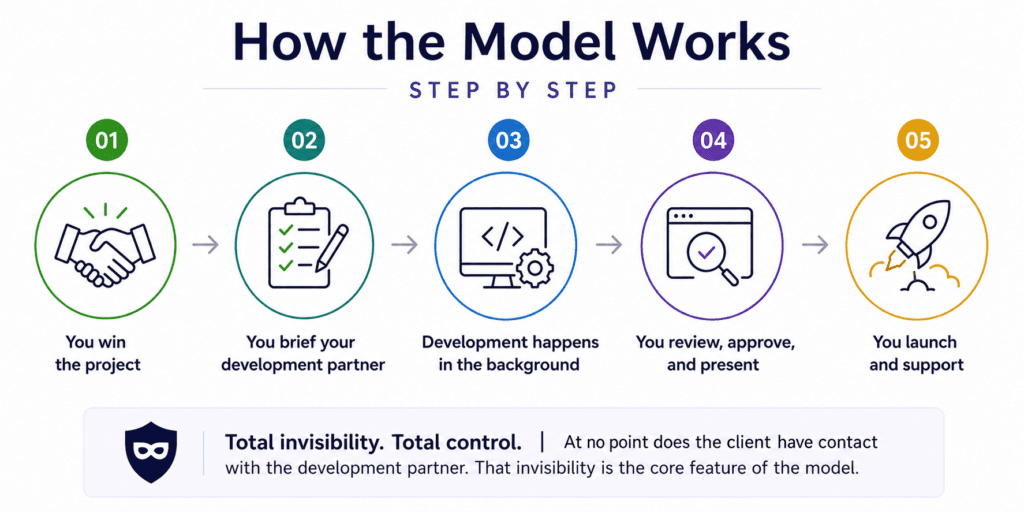
Step 1 : You win the project Your agency handles all business development, proposal writing, and contract signing. The client has no reason to know, and will never know, that a third party is involved.
Step 2 : You brief your development partner You share design files, client requirements, platform preferences, timelines, and any brand guidelines. A professional white label partner has a structured intake process that makes this fast and unambiguous.
Step 3 : Development happens in the background your partner builds on a neutral staging environment. No client-visible URLs carry the partner’s name or branding. The work looks like it came from your team.
Step 4 : You review, approve, and present The work comes back to you for QA and feedback rounds. You approve it and present the output to your client under your agency’s name.
Step 5 : You launch and support The site goes live under your brand. Post-launch maintenance becomes a recurring retainer continuing the client relationship entirely under your name.
At no point does the client have contact with the development partner. That invisibility isn’t incidental it is the core feature of the model.
Why Agencies Choose White Label Development in 2026
The momentum behind white label web development reflects a broader shift in how businesses scale their technology capabilities. According to Deloitte’s 2024 Global Outsourcing Survey, 80% of executives plan to maintain or increase their investment in third-party outsourcing, as organisations increasingly prioritize agility, access to specialized talent, and outcome-based delivery over simply reducing costs. For digital agencies, white label partnerships provide a practical way to expand service offerings, accelerate project delivery, and meet growing client demands without significantly increasing internal overhead
Here is why Agencies are choosing white label Development over In-house Development:
Capacity Without the Headcount Cost
Hiring a senior web developer costs $70,000–$120,000 per year in the US or £50,000–£85,000 in the UK before you factor in benefits (which add 25–35% to base salary), equipment, software licenses, and management overhead.
For a mid-sized agency managing 15–20 concurrent projects, maintaining a team of 5–7 in-house developers costs $700,000–$1,000,000 in total annual employment costs. A white label partner can deliver equivalent or greater output at $350,000–$500,000 with the flexibility to scale up or down as project volume fluctuates.
A white label arrangement converts that fixed cost into a variable one. You only pay for development when you have a paying client in front of you.
Broader Technical Coverage Immediately
Your clients don’t all need the same technology. Some need WordPress. Others need Shopify, a React web app, a Flutter mobile app, eCommerce development, or a Microsoft Power Platform integration alongside their website. Maintaining genuine, up-to-date expertise across all of those platforms in-house is unrealistic for most agencies.
A white label development partner with a full-stack team gives you coverage you can sell confidently without months of recruitment, onboarding, and skill-building.
Speed That Wins Client Relationships
According to research published by Harvard Business Review, businesses that respond to inbound inquiries within one hour are nearly seven times more likely to qualify a lead than those that wait even one additional hour. With an established white label partner already in place, you can accept new development requests immediately often beginning discovery within 24 hours and development within 5–7 business days.
Compare that to the 2-5 month delay of recruiting, hiring, and onboarding a new in-house developer.
Cleaner Strategic Focus
When delivery is handled, your team can focus on what actually grows the agency: client strategy, creative direction, business development, and account growth. You stop being a project management bottleneck on work your team didn’t have the capacity for.
What Services Does a White Label Development Partner Cover?
A capable white label development partner should handle considerably more than basic website builds. Here is what full-scope coverage looks like in 2026:
Custom Website Development Responsive, performant websites built from scratch or on a CMS tailored to the client’s brand and conversion goals. Not templated. Not generic.
WordPress & WooCommerce Development The most common client request globally. WordPress powers over 43% of all websites. Services include custom theme development, plugin builds, WooCommerce storefronts, performance optimization, and multisite setups.
To capitalize on the growing eCommerce market, many agencies choose to hire WordPress developers through a reliable white label development partner, enabling them to deliver high-quality online stores without expanding their in-house team.
Shopify Development Whether your clients need Shopify theme customisation, custom app development, headless Shopify solutions, or store migrations, choosing to hire Shopify developers enables your agency to deliver projects faster without increasing in-house development costs.
React, Angular & Vue.js Frontend Development Modern JavaScript, React JS frameworks for web applications, SaaS dashboards, client portals, and any product that needs to do more than display static content.
Node.js, PHP, Python & .NET Backend Development APIs, databases, authentication systems, third-party integrations, and server-side logic. The technical foundation that powers complex web products.
Mobile app development is increasingly becoming a core service for digital agencies. Whether clients need Flutter, React Native, Android (Kotlin), or iOS (Swift) solutions, agencies can hire Flutter developers for cross-platform apps or hire Android developers to build high-performance native Android applications.
Want to know why Flutter continues to dominate cross-platform development? Check out our in-depth guide on Flutter in 2026: Latest Trends, Roadmap & Is It Still Worth It? for expert insights, industry trends, and practical use cases
Power Platform & Microsoft Solutions: Power Apps, Power BI dashboards, Power Automate workflows, and Dynamics 365 implementations for agencies serving enterprise or mid-market clients with Microsoft environments.
Whether your clients need Power Apps, Power BI dashboards, Power Automate workflows, or Dynamics 365 implementations, you can hire Power Apps developers through a trusted white label development partner to deliver enterprise-grade Microsoft solutions under your own brand.
UI/UX Design Wireframes, user flow mapping, prototypes, design systems, and full visual design before development begins, or as a standalone service for agencies without in-house design.
QA & Testing Functional testing, cross-browser testing, performance testing, mobile responsiveness testing, and accessibility checks before every handoff.
Ongoing Maintenance & Support: Security patches, plugin updates, performance monitoring, content updates, and new feature additions post-launch packaged as a retainer your agency sells to clients.
If a white label partner only covers one or two of these areas, you will hit limits quickly as your client base grows and their needs diversify. Look for partners who cover the full stack.
Who Uses White Label Web Development?
According to recent industry data, 73% of digital agencies have already integrated white label services into their offerings. Across agency types, the model works for:
Digital marketing agencies that win clients on SEO, paid media, or content strategy but get asked for web builds they cannot deliver internally.
Branding and design agencies that complete a visual identity project and want to hand the client a finished, live website not a referral to a separate firm that might steal the relationship.
IT consultancies that advise clients on technology strategy but need a delivery partner to build what they recommend. This is particularly common among Microsoft partner firms and Salesforce consultancies.
Freelance designers who can now offer a production-ready, fully developed website alongside their design work and price it accordingly.
Startup agencies in their early years, using white label as the default delivery model from day one so the founding team stays focused on client acquisition and growth rather than technical execution.
SaaS founders and product companies who need feature development or a new web product built on a compressed timeline without committing to engineering hires.
The common thread across all of these: they win work based on trust, relationships, and strategic thinking. White label gives them the execution layer without requiring them to build or manage a development team.
Pricing: How to Structure It and What Margins to Expect
White label web development is financially compelling because offshore development rates are structurally different from in-house hiring costs in the US, UK, or Australia. A custom web build in North America typically runs $15,000–$150,000+ through a local agency. A white label equivalent built through an offshore partner often costs $3,000–$25,000 with the same quality output.
Target Gross Margins
The industry norm in 2026 is to target 50–70% gross profit margins on white label projects. If your white label partner charges $2,500 for a project, you bill your client $5,000–$7,500 covering your project management time, client communication, quality review, and profit.
Agencies with high project volume often achieve even stronger margins because their operational overhead per project drops as the workflow becomes standardised.
The Three Main Engagement Models
Project-Based Pricing Fixed scope, fixed quote. Works well for a new website, a WooCommerce store, or a specific web app build. You receive a fixed price from the partner, add your margin, and quote the client. Clean and straightforward.
Monthly Retainer Where white label partnerships truly compound. Once a client is on a maintenance or ongoing development retainer, the revenue is predictable, the margin is consistent, and the relationship stays anchored to your agency. Many agencies who start with a one-off project build end up with 12-month retainers running in the background. Flat-rate monthly retainers with white label partners typically start around $1,500–$2,500/month for 15–20 development hours.
Dedicated Developer Model A full-time or part-time developer embedded in your workflow, available for whatever the agency needs, billed at a flat monthly rate. Works particularly well for agencies with consistent monthly project volume and a predictable pipeline.
The Right Pricing Principle
Never price based purely on your partner’s rate. Price is based on the value you are delivering to the client and the accountability you hold. Your agency’s expertise, project management, QA, and client relationship management are worth real margin and clients pay for outcomes, not hours.
The NDA and Legal Protection You Need
This is the step most agency owners either skip entirely or handle with a generic template that does not cover the specific risks of the white label model. Before sharing any client information, project details, or design assets with a development partner, the NDA must be signed and watertight.
What a Proper White Label NDA Must Cover
Identity protection The partner formally agrees never to disclose their involvement to any third party including, and especially, the end client.
No direct client contact An explicit, enforceable prohibition on the partner reaching out to your client for any reason without written approval from your agency. This is non-negotiable.
Brand compliance All deliverables, staging environments, invoices, and communications must carry your branding only. No partner logos, domain names, or contact details should be visible anywhere in the client-facing workflow.
IP assignment All code, design assets, databases, and deliverables become the intellectual property of your agency upon payment. The partner retains no rights to the work.
Non-solicitation clause The partner agrees not to approach your clients directly for their own business during the engagement or for a defined period after it ends.
Breach consequences Clear, enforceable remedies if any term of the agreement is violated. Vague language here creates ambiguity when you can least afford it.
Red Flags to Watch For
- A prospective partner hesitates to sign an NDA before you share project details
- They ask to be introduced to your client “just to align on requirements”
- Their staging environments carry their own domain name or logo
- Invoices arrive with their company branding visible
- They have no documented confidentiality onboarding process
A professional white label development partner understands that the invisibility of the arrangement is the product. If they don’t treat NDA-first as standard operating procedure, look elsewhere.
White Label vs. Freelancers vs. In-House: Honest Comparison
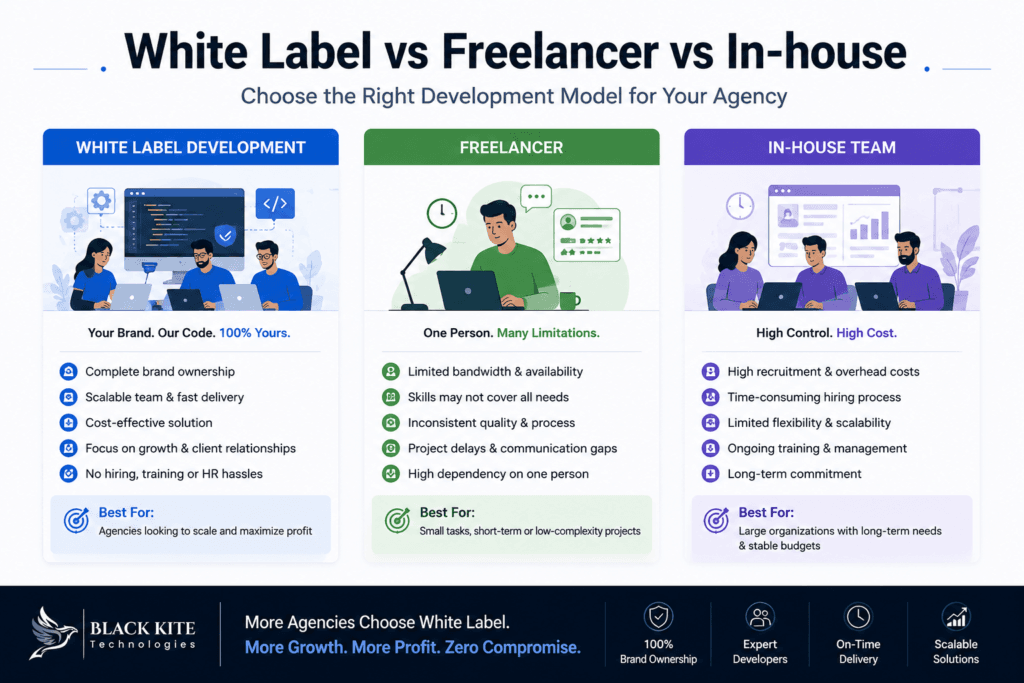
Compare White Label, Freelancer, and In-House web development models to understand which approach offers the best scalability, profitability, and long-term growth for digital agencies in 2026.
| Parameters | White Label Partner | Freelancer | In-house Developer |
|---|---|---|---|
| Annual Cost | Variable; pay per project or retainer | Variable; often lower per hour | $70K–$120K/yr + 25–35% benefits |
| Reliability | Team-backed; built-in cover if one person is unavailable | Single point of failure | Dependent on one individual |
| Confidentiality | Structured NDA; built for agency model | Variable; no formal confidentiality structure | Full control |
| Scalability | Scales up or down with project volume | Capped by one person’s capacity | Requires additional hire to scale |
| Technical Range | Broad full-stack capability across platforms | Limited to one person’s current skill set | Limited to who you hired |
| Delivery Speed | 3–6 weeks typical for standard sites | Unpredictable; no accountability structure | Depends on current internal workload |
| Risk Level | Low; contractual accountability | Medium-high; informal relationship | Medium; depends on staff retention |
| Best For | Consistent development volume needing reliability | One-off, low-stakes tasks with flexible deadlines | High-volume agencies with steady dev pipeline |
The bottom line: Freelancers work for occasional, low-stakes work where the timeline is flexible. In-house developers make sense when you have enough consistent volume to justify the annual overhead. White label is the right model when you are winning development work regularly, need reliability, and cannot yet justify or do not want a full-time in-house hire.
How to Choose the Right Offshore Development Partner?
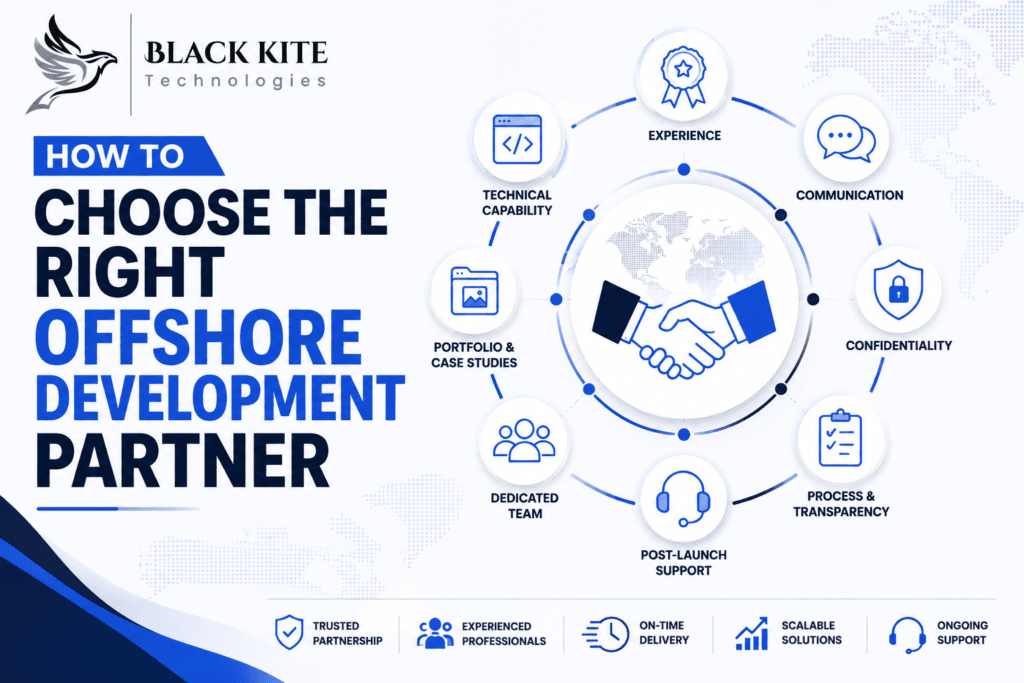
Choosing the right offshore development partner is essential for delivering high-quality web development projects, protecting client relationships, and scaling your agency with confidence.
The quality of your white label partnership directly determines your reputation with clients. Choose carefully.
Technical Capability
Can they build across the platforms and languages your clients will actually need? WordPress and Shopify are table stakes. React, Node.js, Flutter, .NET, and Power Platform are the differentiators that let you say yes to the full range of client requests.
Communication Standards
Do they respond within a business day? Do they flag risks proactively, or do you have to chase project updates? Communication quality is the single biggest differentiator between white label partnerships that work and those that don’t and it shows up clearly in the very first sales interaction. How they communicate before you sign is how they will communicate after.
A Real Portfolio of Agency Work
Ask to see projects they have delivered for other agencies not their own marketing website or generic case studies. Actual client builds, ideally in industries or technology stacks relevant to your work. Ask for references from other agencies, not just end clients.
A Dedicated Project Management Layer
Is there a project manager between you and the developers? Or do you coordinate directly with the engineers? A partner with a proper PM layer is significantly easier to work with at scale and means you spend less time managing the relationship.
Confidentiality as Standard Not on Request
Do they present their NDA as a default first step? Do staging environments use neutral or partner-branded URLs? Do invoices arrive without their branding? These operational details matter in the day-to-day reality of running client projects.
Clear Revision and Scope Policy
How many rounds of revisions are included? What happens when scope changes mid-build? Understanding this upfront eliminates the most common source of friction in white label relationships.
Post-Launch Accountability
Can they support the site after launch? If a critical bug surfaces a week after delivery, are they accountable for it under the existing agreement?
Our practical recommendation: Before committing to a long-term arrangement, run a pilot project. A single small build tells you more about communication, code quality, and process than any amount of sales conversation.
Need a Reliable White Label Development Partner?
Scale your agency with experienced developers specializing in WordPress, Shopify, Flutter, Android, Power Apps, and custom web development. Deliver projects faster, increase profitability, and grow your business without expanding your in-house team.
Common Mistakes Agencies Make And How to Avoid Them
Most white label partnerships that fail do so for the same predictable reasons:
Choosing on price alone The cheapest rate almost never produces agency-grade work. Underpaying a white label partner creates the same problems as underpaying any supplier corners are cut where you cannot see them, and the cost shows up later in client dissatisfaction or rework.
Skipping the pilot project Committing to a long-term retainer without testing the relationship first is entirely avoidable risk. One test project changes everything you need to know.
No structured brief process Vague project briefs produce vague output. The quality of what comes back reflects directly the quality of what you sent in. Create a standardised project brief template and use it consistently.
A weak or generic NDA A standard freelance NDA does not cover the specific risks of white label development. Get one written specifically for this model.
Overpromising timelines to clients Build buffer into every client-facing timeline you give. White label delivery involves coordination across teams and time zones, and scope changes need room to breathe.
Treating the partnership as purely transactional The agencies that get the best results from white label development invest in the relationship. Regular communication, honest feedback, and consistent project volume build the kind of partnership where a good development team prioritises your projects and goes the extra mile when something urgent comes up.
Ready to Scale Your Agency Without Scaling Your Headcount?
At Black Kite Technologies, we work as the invisible development partner for digital agencies and IT consultancies across the US, UK, Australia, and beyond.
Our team of 30+ developers covers the full technical stack:
- Custom web development (React, Node.js, PHP, .NET, Python)
- WordPress & WooCommerce
- Shopify & eCommerce
- Mobile apps (Flutter, React Native, Android, iOS)
- Microsoft Power Platform (Power Apps, Power BI, Power Automate, Dynamics 365)
- UI/UX Design & QA Testing
We operate under strict NDA from day one. All deliverables go out under your brand. Your clients only ever see you.
See what our clients have to say. Explore our Clutch profile to read verified client reviews, ratings, and success stories from businesses we’ve helped worldwide.
How to choose white label Development Agencies: Frequently Asked Questions (FAQ)
Q. What is White Label Web Development?
White label web development is a business model where a specialized development company builds websites or web applications on behalf of another agency. The agency sells the project under its own brand while the development partner remains invisible to the end client. This allows agencies to expand their service offerings without hiring an in-house development team.
Q. How does White Label Web Development work?
A white label web development partner works as an extension of your agency. Your agency manages client communication, project strategy, and branding, while the development partner handles design, coding, testing, deployment, and technical support. The final product is delivered under your agency’s name, ensuring a seamless client experience.
Q. What are the benefits of White Label Web Development for agencies?
White label web development helps agencies:
- Scale without hiring additional staff
- Reduce operational costs
- Deliver projects faster
- Access experienced developers
- Expand service offerings
- Improve profitability
- Focus on client acquisition and business growth
- Handle multiple projects simultaneously
For growing digital agencies, it is one of the most cost-effective ways to increase revenue while maintaining high-quality delivery.
Q.Is White Label Web Development profitable?
Yes. White label web development is highly profitable because agencies can purchase development services at wholesale pricing and resell them at their own rates. This creates healthy profit margins while eliminating recruitment, infrastructure, and employee management costs.
Many agencies increase their profitability by 30%–60% through long-term white label partnerships.
Q. What’s the difference between White Label and Outsourcing?
Although both involve external development teams, they are different.
With traditional outsourcing, clients often know that work is being completed by a third-party company.
With white label development, the external team remains completely behind the scenes, allowing your agency to maintain full ownership of the client relationship, branding, communication, and deliverables.
Q. Which services can be offered through White Label Web Development?
A white label partner can provide a wide range of services, including:
- Custom Website Development
- WordPress Development
- Shopify Development
- WooCommerce Development
- Magento Development
- Laravel Development
- React Development
- Angular Development
- Vue.js Development
- Next.js Development
- Node.js Development
- PHP Development
- Python Development
- .NET Development
- API Development
- CMS Development
- Website Maintenance
- UI/UX Design
- Quality Assurance Testing
- Website Optimization
- Website Migration
- Performance Optimization
Many agencies also use white label partners for ongoing maintenance and dedicated developer hiring.
Q. Who should use White Label Web Development?
White label web development is ideal for:
- Digital Marketing Agencies
- Web Design Agencies
- SEO Agencies
- Branding Agencies
- Creative Studios
- Software Companies
- IT Consultants
- Startup Agencies
- Freelancers
- Business Consultants
Any business that wants to offer web development without building an internal technical team can benefit from white label services.
Q. Is White Label Web Development suitable for startups?
Absolutely.
Startups and small agencies often have limited budgets and resources. White label development allows them to compete with larger agencies by delivering enterprise-quality websites without investing in full-time developers.
Q. Is White Label Web Development secure?
Yes, provided you work with a trusted development partner.
Professional white label companies typically use:
- Non-Disclosure Agreements (NDAs)
- Secure repositories
- Access control
- Encrypted communication
- Secure cloud infrastructure
- Version control systems
- Code review processes
- Data protection best practices
These measures help ensure complete confidentiality and project security.
Q. Can clients know that a White Label partner is involved?
No.
A professional white label development company operates entirely behind your brand. All communication, documentation, and deliverables can be customized with your agency’s branding, ensuring clients see only your business.
Q. How do I choose the best White Label Web Development company?
Look for a partner with:
- Proven portfolio
- Positive client reviews
- Strong technical expertise
- Transparent communication
- Flexible engagement models
- Dedicated project managers
- Agile development process
- Post-launch support
- Quality assurance practices
- Scalable development team
Request case studies and conduct a technical discussion before starting a long-term partnership.
Q. How much does White Label Web Development cost?
The cost depends on project complexity, technology stack, timeline, and engagement model.
Common pricing models include:
- Hourly Pricing
- Fixed Project Pricing
- Dedicated Developer Model
- Monthly Retainer
Compared to maintaining an in-house team, white label development often reduces costs by 40%–70%.
Q. Can White Label Development teams work in my time zone?
Yes.
Most established white label companies support multiple time zones, including the USA, Canada, UK, Europe, Australia, New Zealand, and the Middle East. Many also provide overlapping working hours for faster collaboration and communication.
Q. Can a White Label partner handle large enterprise projects?
Yes.
Experienced white label companies have dedicated teams of developers, UI/UX designers, QA engineers, DevOps specialists, and project managers capable of delivering enterprise-grade web applications, SaaS platforms, eCommerce solutions, ERP systems, CRM platforms, and custom business applications.
Q. Can I hire dedicated developers through a White Label partner?
Yes.
Many white label companies offer dedicated developers who work exclusively on your projects. This model provides better collaboration, faster delivery, and greater control while eliminating recruitment and HR overhead.
Q. Why should agencies partner with Black Kite Technologies for White Label Web Development?
Black Kite Technologies helps digital agencies scale confidently with reliable white label web development services. Our experienced developers, transparent communication, agile workflows, strict confidentiality, flexible engagement models, and commitment to quality enable agencies to deliver exceptional web solutions under their own brand. Whether you need a dedicated development team or support for individual projects, we become a seamless extension of your agency, helping you grow faster while maintaining complete client ownership.